Saturday, October 26, 2013

Ocean Towels Are Done!

I finished weaving the Ocean Towels today. They've been washed and dried, now the hand-hemming process starts. I'm super-pleased with these towels - they're really soft and thirsty. The pattern is a linked birdseye, and I used 6/2 unmercerized cotton sett at 16 ends per inch. I have 10 towels - 1 to keep, 1 for my swap partner, and 2 for gifts. That leaves 6 for the shop.

I'll take more pictures when they're hemmed and pressed, but I couldn't resist showing them off now!

This is fresh off the loom, before washing

After a trip through the washer and dryer - ready to hem!

Monday, October 21, 2013

HAT!

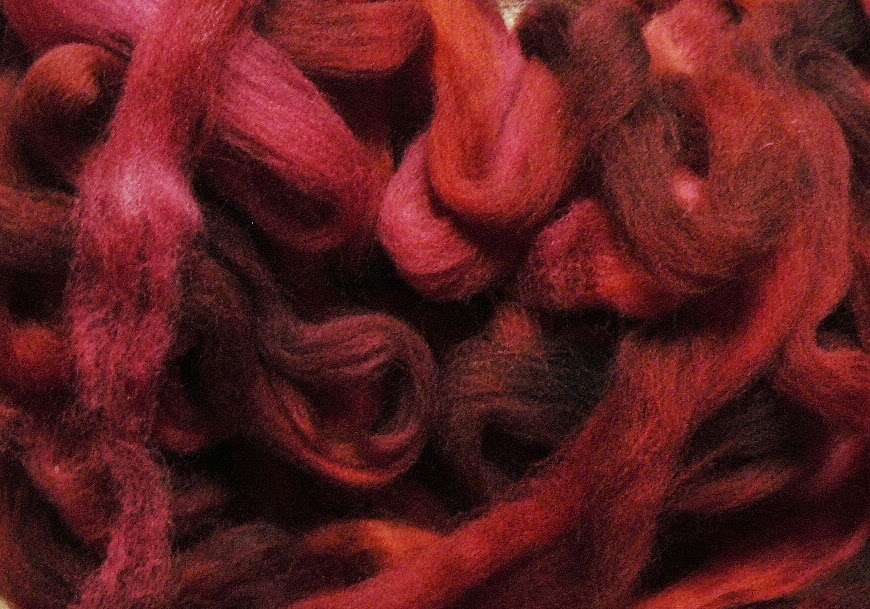
The weather has finally cooled here - we dipped into the 60's last night and it feels great! Of course, nowhere near as cool as Montana for our vacation 2 weeks ago, where the temps were in the 30's and 40's. Still, cool weather makes it nicer to knit with wool, and I decided I wanted a new hat. A RED hat. So I dug into my extensive fiber stash and came up with some lovely tonal red targhee wool, dyed by Mountain Colors:

I spun it up into a lovely bouncy 2-ply worsted weight yarn:

And knit myself a hat!

I won't get much use out of it here, alas. But anytime we can get away and go back to the mountains, I'm ready!


Thursday, October 17, 2013

My Happy Place

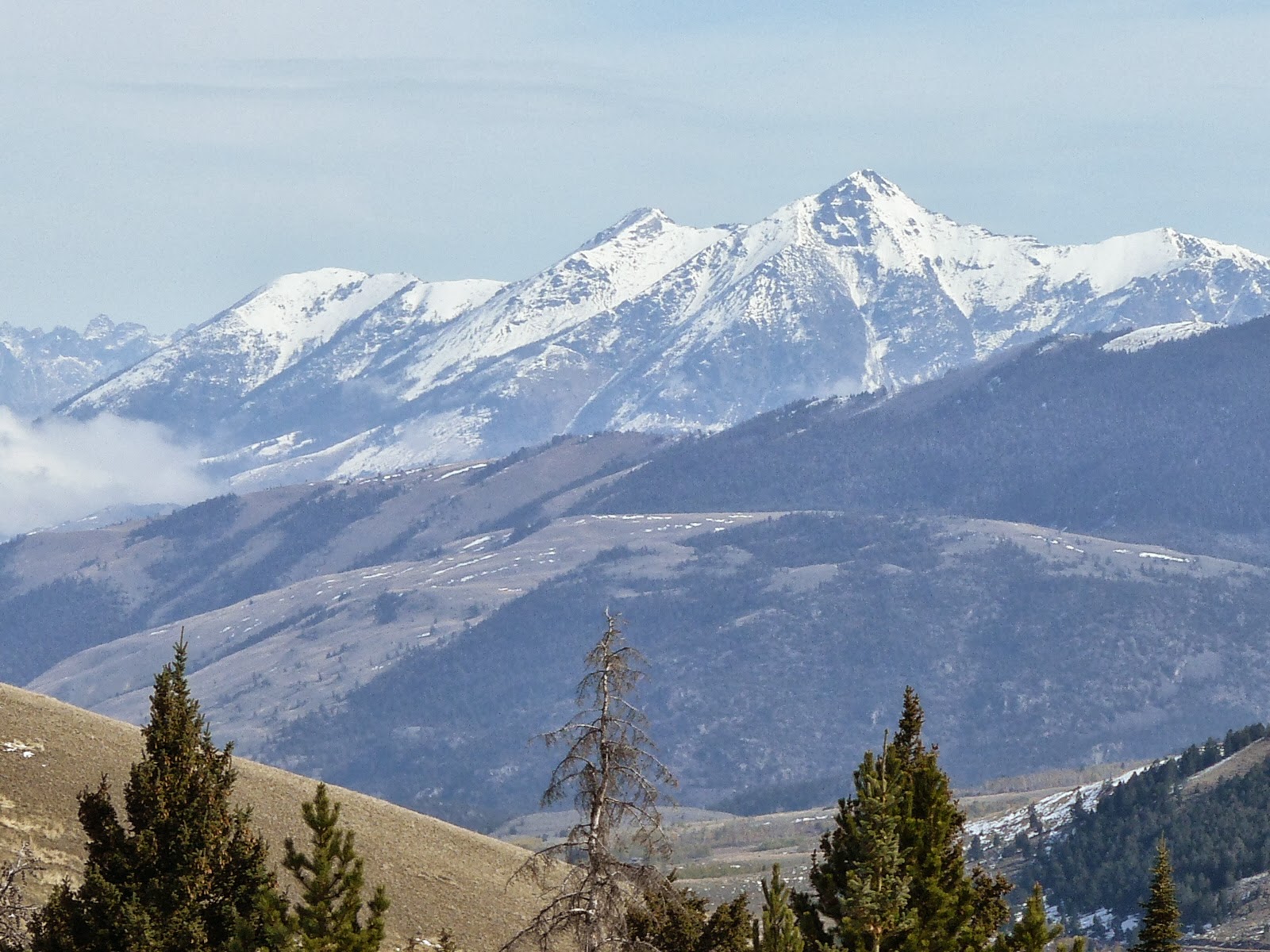
Our hearts are in the mountains - that's where we spend every vacation we can possibly manage. We're blessed to be able to go every 18 months or so and spend a week in the Rockies. Montana with its National Parks (Glacier and Yellowstone) is our favorite place of all.

Last week we spent a week in our idea of heaven. Alas, the National Parks were closed due to government gridlock, but we had a wonderful time anyway, driving through spectacular scenery and enjoying the dry cool air. We stayed in Gardiner, right outside Yellowstone. We were sorry to leave, and can't wait to go back!


Wednesday, October 2, 2013

Quick, To The Charkha!


I've been planning to spin and weave a set of curtains for my studio window for AGES, and I keep starting and stopping on the project due to the "oooo, shiny!" distraction factor. Some friends who are also Doctor Who (my favorite show!) fans encouraged me to get it going again... it turned into a "dissertation". Now I HAVE to finish, right? RIGHT??

Team: Tardis
Category: Encyclopedia – C for Charkha
Craft: Spinning
Summary: My plan is to spin cotton singles on the charkha for the yarn for a future project of weaving sheer lace curtains for my studio (both the warp yarn and the weft yarn). I will need 4500 yards of 2-ply yarn, 10/2 weaving weight (34 wpi, 4200 ypp). The charkha will be used to spin the singles only. (I'll ply using the woolee winder on my electric spinner.) My sample is right on, 34 wpi (shown as 17 wraps per half-inch). I estimate that I’ll need 18 oz of cotton roving to get my needed yardage (including waste).


The Charkha
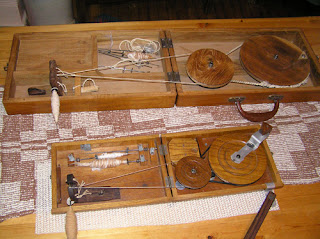
The charkha is a small, portable, hand-cranked wheel, ideal for spinning cotton and other fine, short-staple fibres, though it can be used to spin other fibres as well. The tip of the charkha spindle reaches faster speeds than the usual treadle wheel flyer, making it easier to quickly achieve high amounts of twist.  The charkha works similarly to the great wheel, with a drive wheel being turned by hand, while the yarn is spun off the tip of the spindle. The floor charkha and the great wheel closely resemble each other. With both, the spinning must stop in order to wind the yarn onto the spindle. The tabletop or floor charkha is one of the oldest known forms of the spinning wheel. The most common type of charkha available in the U.S. is more strictly identified as the box charkha, in “book” and “briefcase” or “attache” sizes.


Chiefly responsible for the widespread use of the charkha, Mohandas K. Gandhi was the preeminent leader of Indian nationalism in British-ruled India in the early part of the 20th century. Employing non-violent civil disobedience, Gandhi led India to independence and inspired movements for civil rights and freedom across the world. Cotton was grown in India where the men would harvest it and the British would ship this cotton back to England and have it woven and spun into cloth which was then shipped back to India and sold at a price that the people could not afford.  In order to resist the British, Gandhi encouraged the men to spin (traditionally women’s work), weave their own cloth and wear clothing made from this homespun cloth.  This cloth was called “khaddar” or “khadi” (meaning “rough”). This experiment of Gandhi’s eventually forced the British to leave India because the men were not harvesting the cotton, and the use of khaddar cut out the market for the British made cloth.  India eventually gained economic independence from England.  Some Indian money and stamps have a charkha image, and the Congress Party in India placed a charkha wheel design on their flag.


As part of the passive resistance movement, Gandhi would often spin in public.  On many occasions, he would spin and recommend spinning to others, saying it would bring them peace of mind.


 Since the traditional charkha was typically bulky and difficult to move, Gandhi needed a charkha that would be compact, portable and affordable.  Various models of box charkha were designed and then manufactured. The double-wheel drive, which allows greater speed and control as well as portability, was Gandhi’s own innovation.


 I’ll be using my Bosworth book charkha. My favourite position for spinning with the charkha is seated in a chair with the charkha in my lap. I place a piece of non-slip cloth under the charkha to keep it stable.


 Time Justification: It takes me a solid 2 hours to spin and ply 100 yards of 2-ply yarn this fine. So I estimate it will take me a minimum of 45 hours to spin and ply this yarn. Since there are 90 days in this term (Oct. 1st-Dec. 28), I’ll need to spin/ply for an average of 2 hours per day.
Team Tie-In: This fine white yarn will be used for weaving lace curtains, which will be gauzy and free-flowing and sheer and translucent, like the bridal veils worn by Amy Pond and Donna Noble, both companions of The Doctor.


 Wish me luck!!!

Friday, September 27, 2013

Ocean Towels

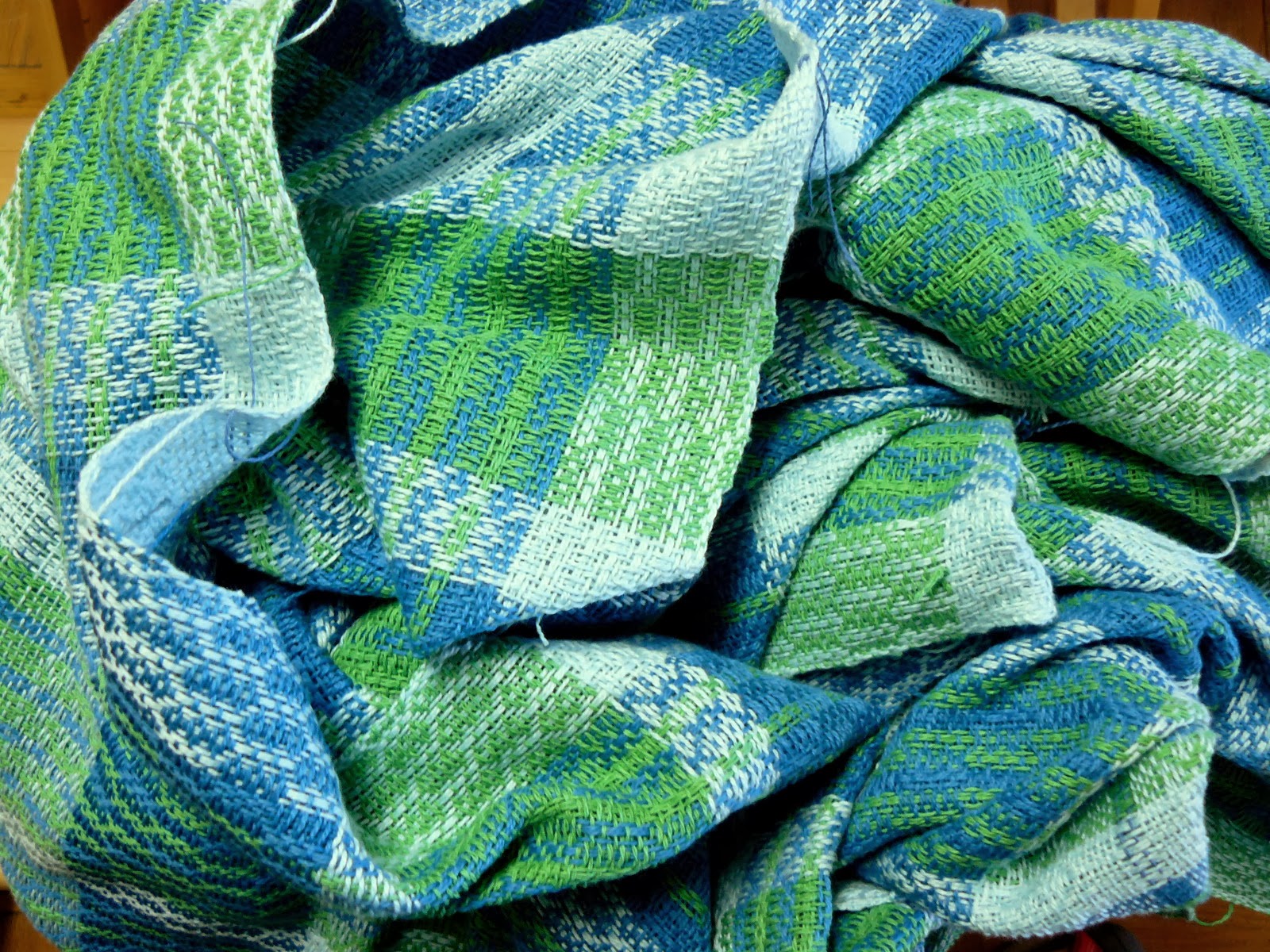
Dishtowels, Linked Birdseye pattern, 6/2 unmercerized cotton, blue and green and very pale blue (looks white in the picture):

I've warped for 8 towels - one for a swap partner, one for me, 6 for the shop. I love this color combination!

Sunday, July 28, 2013

Tour de Fleece 2013

July is always a blur, spent spinning during every available waking moment. Why? It's the Tour de Fleece,  a fun event that happens every year at the same time as the Tour de France cycling race (22 days). Ravelry hosts the Tour. Spinners challenge themselves personally and on teams, deciding whether they'll try for extreme yardage, extreme fibers, extreme amounts, extreme... well, you get the idea. It's all in fun, and prizes are awarded randomly, so it's not a competition (unless you want it to be).

I usually strive for a high number of skeins finished, and try to spin a variety of fibers from my favorite dyers. This year I started with a bin full of assorted handdyed wool from Southern Cross Fibre, Hello Yarn, Enchanted Knoll Farm, and Spunky Eclectic. The white is cotton.


I had several challenges for myself this year - first year acting as a Moderator in the Tour, attempting to spin as many different skeins as I could in the time I had, spinning skinny cotton on the charkha for a long-term handwoven handspun cotton curtain project, being sidelined by cataract surgery near the end.

But one thing never changes about the Tour for me - it’s FUN! I don’t worry about what others are doing, it’s all about ME ME ME. :) I challenge myself to reach higher and farther, and enjoy every bit.

I finished 12 skeins for the Tour, totaling 39 oz, nearly 2.5 pounds. Here’s their unwashed group yearbook picture.


The center skein is cotton, spun on my charkha: 0.4 oz (11g), 240 yards, 2-ply, 23/2 cotton weight, 9600 ypp (80 wpi).

Total Tour yardage this year: 4,113 yards. Yay!

Friday, June 7, 2013

Retreat Spinning

I was away this weekend at the annual SWIC (Spinners and Weavers of Imperial Calcasieu) Retreat. I love this retreat - we meet for 3 days of spinning and weaving and TALKING and sharing and eating and SHOPPING. It's like a spinner-slumber-party!

I bought some gorgeous red Gulf Coast Native wool from Margrett, and a bunch of stuff from Peggy at Skyloom Weavers: polwarth, panda, natural CVM, shredded blue jeans, and sari silk.

Here's what I spun while I was there:

Pigeonroof Studios, 'Water Lily', chunky thick/thin 2-ply, 120 yards

Pigeonroof Studios, 'Fruit Juice', chunky thick/thin 2-ply, 120 yards

Skyloom Weavers, 'Crayons', worsted wt n-ply, 160 yards

Art at Eagles' Find, 'Forest', worsted wt 2-ply, 190 yards
I also spun 3 full spindles of cotton on the charkha, then plied it into a skein of laceweight (8/2 for the weavers) 2-ply, 300 yards. I'm going to show you that later this weekend - I haven't boiled it yet. It's going in the handspun cotton stash that I'm building up for weaving handspun curtains - a long-term project, but SO satisfying!

Tuesday, May 28, 2013

Spectrum Warping

Warp wound on the warping mill:


Sleyed through the reed:


Threading heddles:


Monday, May 27, 2013

Spectrum Seedlings

They're sprouting up in the garden, so they must be seedlings, right?


This is a kit from Lunatic Fringe, in their Tubular Spectrum series. It's 10/2 cotton in 20 different shades. I'm weaving a scarf for my dear friend Cass, who loves rainbows. It'll be plainweave/tabby, in a color gamp pattern - the colors will go across the scarf following the spectrum, and as I weave I'll change colors the same way. It will be a very cool scarf, and I can't wait to see the results. I'm winding the warp today.

Sunday, May 26, 2013

First Harvest!

We are having so much more success this year with the garden than last year. Last year's poor plants cooked in their containers and gave us no fruit/veggies. So sad. This year the garden is looking fine and healthy.  We have the square garden plot (8'x8') and a bed along the wood fence.


The tomatoes, lettuce, beans, and zucchini are doing so well!


Aaaaaand, first harvest - lettuce and two types of bush beans: